Peer-reviewed papers, clinical abstracts, and conference posters spanning
clinically validated biosignal ML, cognitive neuroscience and language
processing, and language model evaluation. Full list on Google Scholar.
Clinical biosignal entries reference three study programmes:
SEPARATE (in vivo peripheral arterial clot trial, 17 patients), E-SEPARATE (ex vivo thrombus validation versus histology, 15 patients), and INSPECT (first in human lung tissue classification during bronchoscopic biopsy, 26 patients). See also medical device AI, biosignals, and neuroscience & language.
Clinical AI & biomedical signal validation
Clinically validated machine learning (ML) on biomedical signals: peripheral arterial clot trials, lung biopsy tissue classification, and multimodal psychiatric biomarkers from clinical trial cohorts.
Peripheral arterial clot characterisation
SEPARATE and E-SEPARATE evaluated impedance based clot characterisation with the Clotild® smart guidewire (Sensome). Bioimpedance targets clot tissue rich in red blood cells.
Clinical abstract
In vivo identification of clot rich in red blood cells in peripheral arterial disease (SEPARATE study)
In vivo clinical validation (n = 17); 100% primary endpoint success for lesion impedance data. Clot identification in peripheral arterial disease (tissue rich in red blood cells).
Also presented at Paris Vascular Insights (PVI) 2024, Paris
JET OPEN the world 2025, Osaka
2025
Clinical · in vivo
First author
Clinical abstract
Ex-vivo thrombus analysis in peripheral arterial disease versus histology (E-SEPARATE study)
Ex vivo machine learning (ML) versus histology gold standard (n = 15); coefficient of determination R² = 0.79 in peripheral arterial disease.
Also presented at Paris Vascular Insights (PVI) 2024, Paris
JET OPEN the world 2025, Osaka
2025
Preclinical · ex vivo
First author
Lung tissue classification during bronchoscopic biopsy
INSPECT used bioimpedance on a bronchoscopy stylet for tool-in-lesion confirmation during biopsy of central and peripheral lung lesions (Sensome).
Clinical abstract
In situ lung tissue characterisation during bronchoscopic biopsy (INSPECT study)
Machine learning (ML) tissue classification during bronchoscopic lung biopsy; 26 patients across Australia and France.
American Thoracic Society (ATS) 2026 International Conference
Multimodal model predicting treatment response across four psychiatric conditions in pooled clinical trial cohorts. Christos led biosignal and imaging feature extraction (EEG, ECG, galvanic skin response).
Conference poster
Transprognostic treatment-response prediction across depression, ADHD, OCD, and PTSD
Major depressive disorder, ADHD, OCD, and PTSD; external validation on unseen clinical cohorts (TRIPOD Type 4); ranked first in the TDBRAIN international competition.
6th Neuropsychiatric Drug Development Summit, Boston
2022
Clinical · external validation (unseen cohort)
Third author · biosignal and imaging feature extraction lead
Cognitive neuroscience & language processing
MEG and EEG during sentence reading, contrasted with a recurrent language model (*Cortex*), and grammatical agreement in humans versus language models (EMNLP 2023).
Human language processing and computational language models (*Cortex*)
PhD work at NeuroSpin / Sorbonne University: how humans and language models process sentence structure. MEG/EEG during reading versus a two-layer long short-term memory (LSTM) language model.
Peer-reviewed journal
Disentangling Hierarchical and Sequential Computations during Sentence Processing
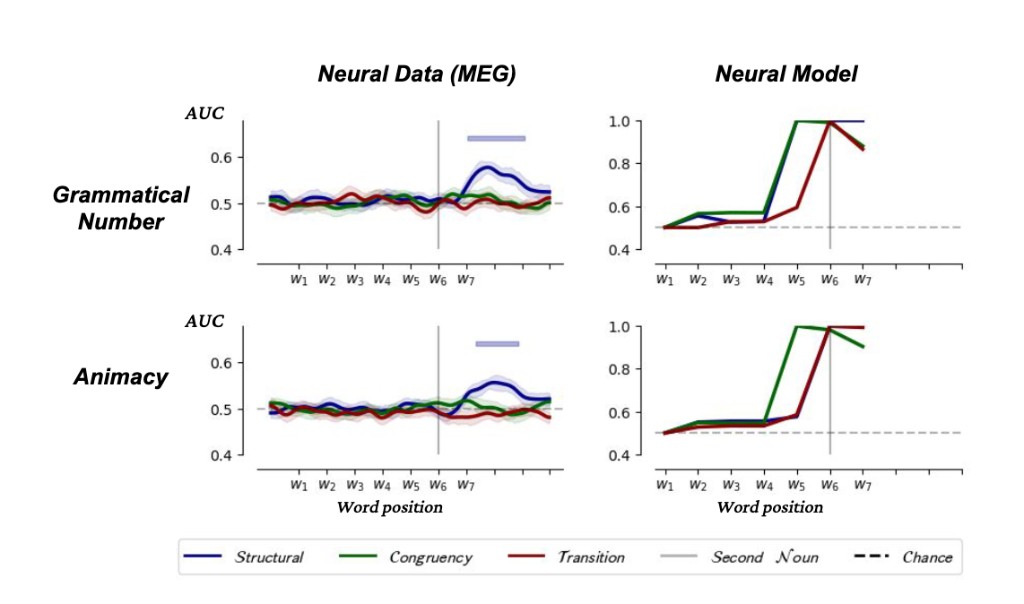
n=22; combined MEG and EEG during sentence reading. Only hierarchical structure was decodable from brain signals; transition and congruity stayed at chance. A two-layer LSTM on the same sentences showed all three effects decodable.
Human MEG/EEG (left): structural effect only; transition and congruity at chance. LSTM (right): structural, transition, and congruity effects decodable. Zacharopoulos, Dehaene, Lakretz, Cortex 2026.
Cortex (Elsevier)
2026
First author · corresponding author
Psycholinguistics and computational modelling
Human grammatical agreement versus language models. First-author EMNLP 2023 main-track paper with Meta AI and NeuroSpin co-authors.
Conference paper
Assessing the influence of attractor-verb distance on grammatical agreement in humans and language models
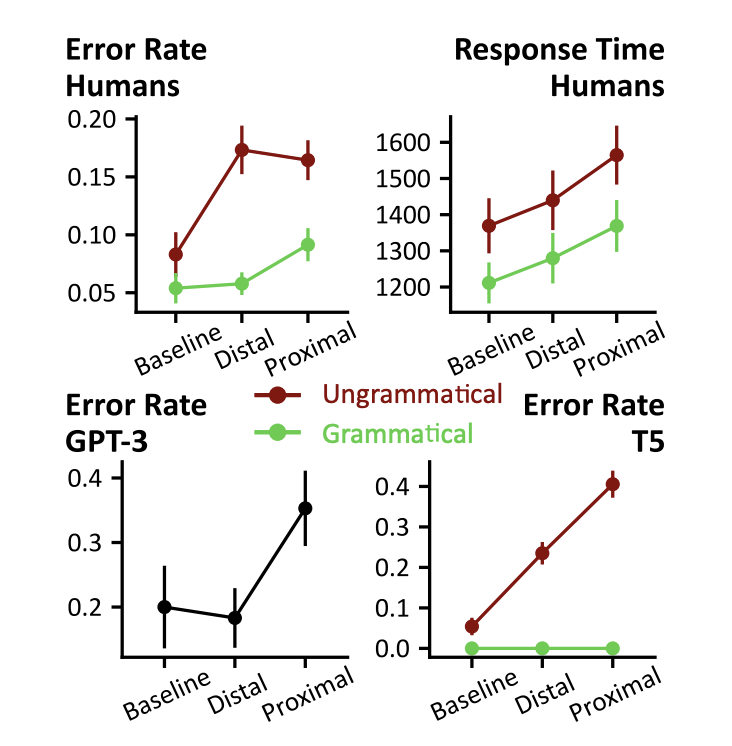
Rapid serial visual presentation agreement task (n=34): humans and language models err more with proximal attractors; linear response-time effect of distance; GPT-Neo-1.3B and grammar-corrected T5 compared to humans.
Human and language-model error rate and response time by attractor distance and grammaticality (from paper; fig. 2).
EMNLP 2023 (Empirical Methods in Natural Language Processing), main track
2023
First author
Language-model evaluation & representation
Computational studies of large language model (LLM) behaviour and internal representations: personality-trait expression and semantic-violation detection in causal LMs.
LLM evaluation and representation analysis
Personality-trait probing and layer-wise semantic-violation decoding in causal language models.
Conference paper
Decoding Emergent Big Five Traits in Large Language Models: Temperature-Dependent Expression and Architectural Clustering
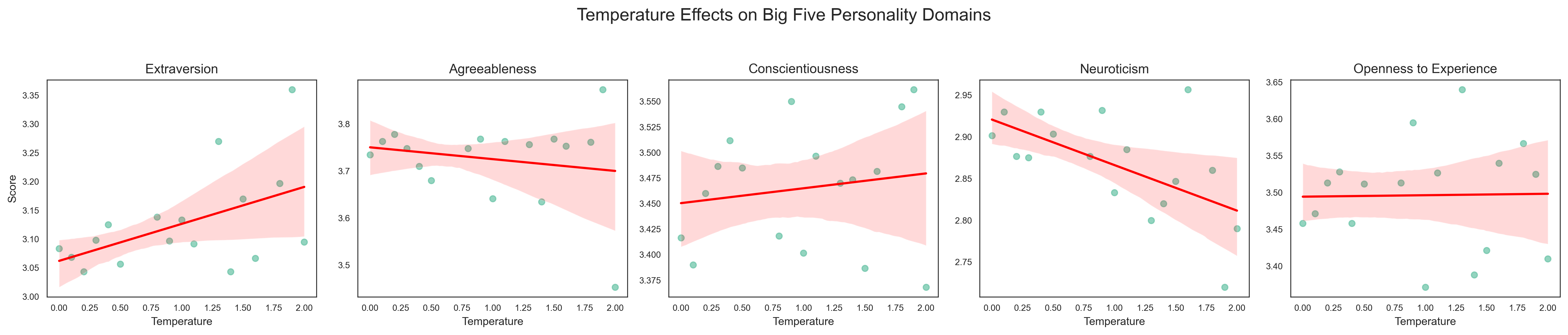
Six LLMs, BFI-2, temperature 0–2: four traits differ across models; Neuroticism and Extraversion track temperature (R² = 0.35 / 0.25).
Temperature effects on trait expression (from paper). Neuroticism and Extraversion are most sensitive to sampling temperature.
IJCNLP 2025 (International Joint Conference on Natural Language Processing)
2025
First author · corresponding author
Conference paper
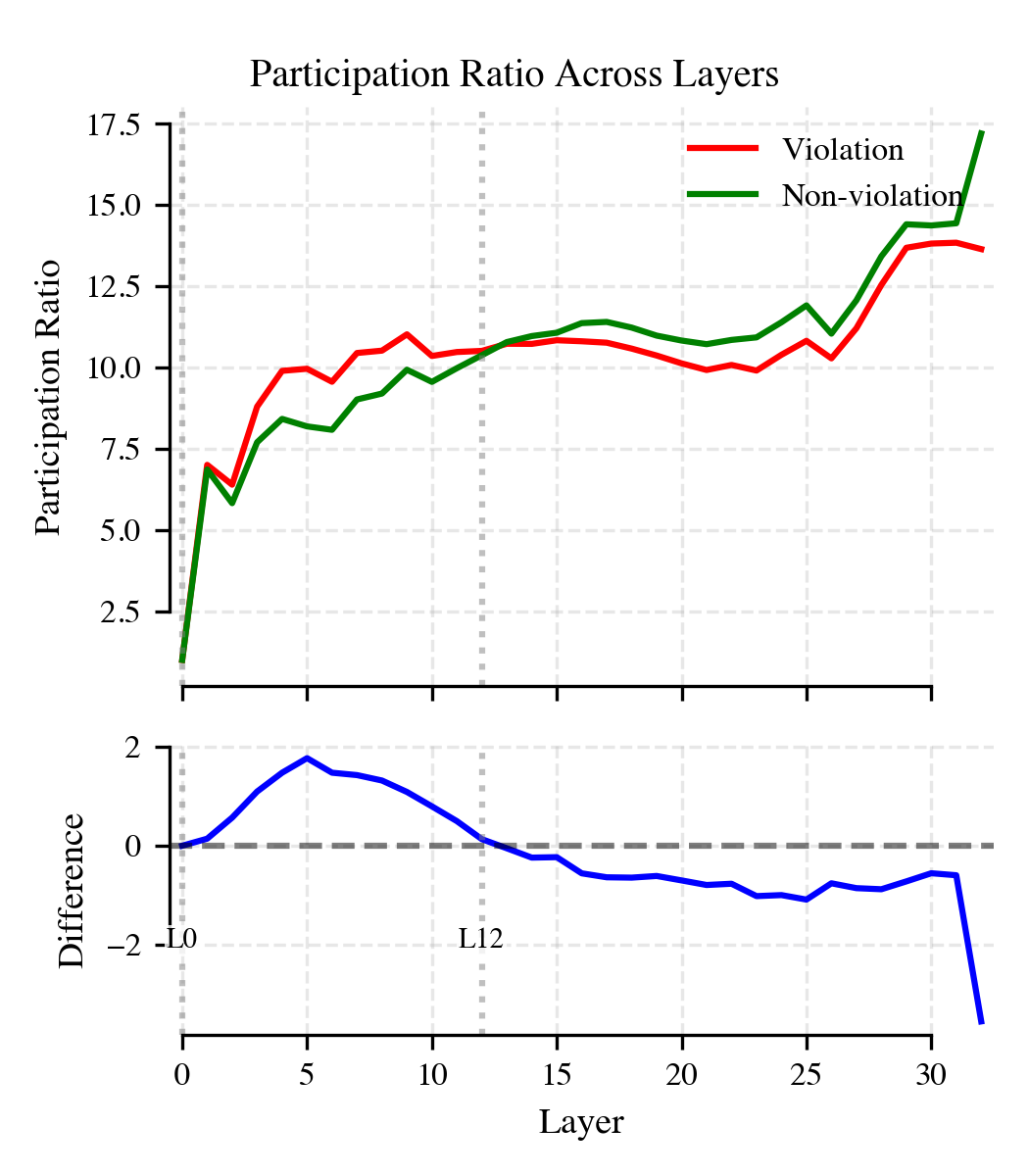
In Machina N400: Pinpointing Where a Causal Language Model Detects Semantic Violations
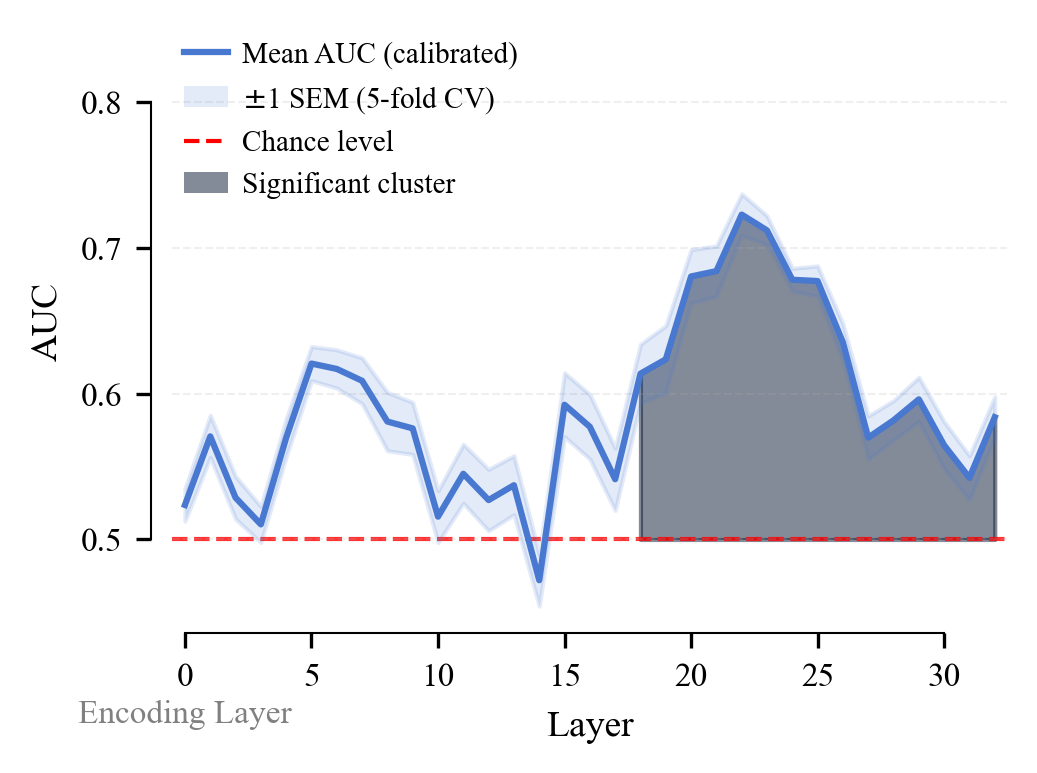
Phi-2, 1520 sentence pairs: per-layer AUC shows semantic violations decoded in layers 18–30 (cluster p < 0.001); early layers at chance; participation ratio expansion then collapse.
Mean ROC-AUC by layer; grey band marks layers 18–30 above chance after cluster permutation (p < 0.001).Participation ratio by layer: early expansion for violations, mid-stack convergence, later compression (from paper).
Springer CCIS / AICS 2025
2025
First author · corresponding author
Earlier work
Earlier contributions before the clinical-AI and NeuroSpin research lines.
Valence and arousal ratings for Hellenic words
Cross-sectional psychometrics (Aristotle University of Thessaloniki): valence and arousal norms across the adult lifespan.
Conference abstract
Valence, and arousal ratings for Hellenic words by young, middle-aged, and older adults
Cross-sectional study (n = 84): older adults rated Hellenic words more positively and with higher arousal than younger groups; age-by-valence interactions across pleasant, neutral, and unpleasant word sets.
SAN2016 Meeting, Corfu · Frontiers in Human Neuroscience (conference abstract)